Pay — Payture side
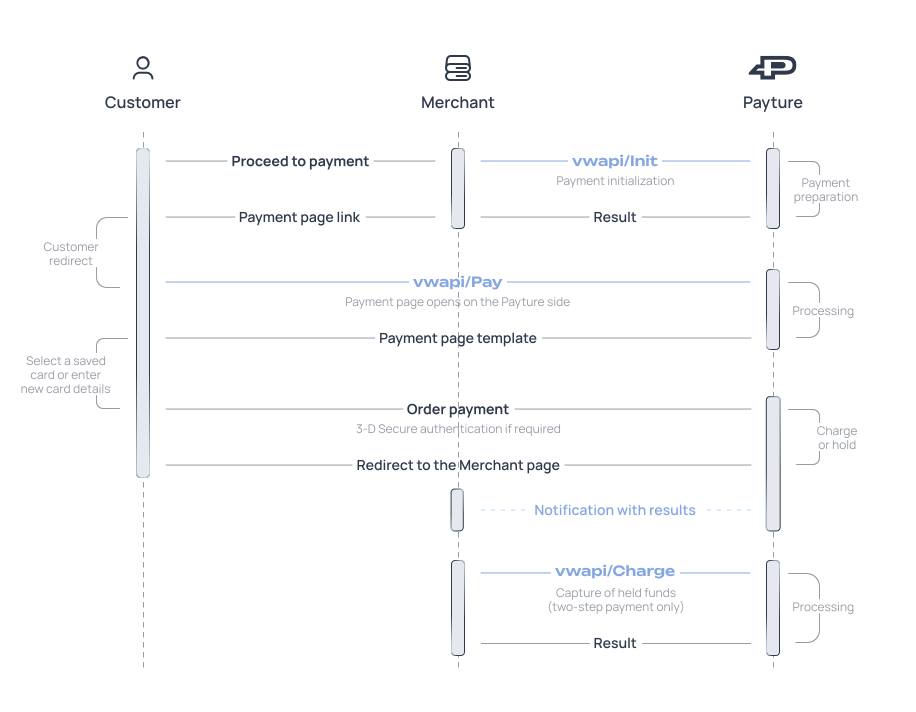
https://{Environment}.payture.com/vwapi/PayThe command opens the payment page on the Payture payment gateway side. It is sent after a successful Init payment initialization command.
On the payment page, the Customer can select a previously registered card or enter the details of a new card to be used for the payment.
Interaction flow
Request
curl https://sandbox3.payture.com/vwapi/Pay \
-d SessionId=c8cc6c5c-30da-d7e1-e090-46f25ae30626 \Parameter names in requests are case-sensitive
The request can be sent using the GET or POST method.
| Parameter | Description | Format |
|---|---|---|
| SessionId | Payment session identifier. Contained in the response to the Init request By default, the session lifetime is 60 minutes. It can be changed via Payture support | String Mandatory |
A successful operation opens the payment page on the Payture payment gateway side.
After the Customer's bank card details are entered, the Customer's card is charged (for a one-step payment) or the funds on it are held (for a two-step payment).
The operation results are shown to the Customer on the payment page, and after 3 seconds the Customer is redirected to the return page (the Url parameter of the Init request).
Important!
You may include the Success parameter in the Customer return URL (Url) to indicate whether the operation completed successfully (takes the values True/False). However, the Success parameter is vulnerable to manipulation by fraudsters and cannot serve as a guarantee of a successful payment. It may only be used to determine the further behavior of the frontend of the Merchant's system.
To get the actual transaction results, use the data received in the notification or in the transaction status request.
Init
The command initializes a one-step payment, a two-step payment, or the add-card process. The request creates a session and prepares for redirecting the Customer to the Payture payment gateway page to enter bank card details.
Pay — merchant side
The command makes a payment when payment card details are entered directly on the Merchant's web page or in the Merchant's mobile app. It charges funds in a one-step payment or places a hold on funds in a two-step payment.